

In this content, various techniques and methods will be presented to recover deleted contacts from iPhone and Android devices, ensuring the security and integrity of your data.
We will cover everything from the native processes of the systems to practical tips to avoid new losses, so don't miss the complete content.
Continue reading and discover all the detailed strategies to restore your contacts and keep your information protected.
Table of Content
Understanding Contact Loss
Contact deletion can occur for various reasons and often unexpectedly. Identifying the causes is fundamental to adopting the correct measures for recovery and prevention. Below, we list some of the most common causes:
- Accidental deletion: it is common that, when cleaning the address book or during the deletion of duplicate contacts, errors occur and important contacts are removed unintentionally;
- Synchronization failures: problems during synchronization with the Google or iCloud account can lead to data loss, especially if the connection is unstable or if there are errors in server updates;
- System updates: in some cases, iOS or Android updates can cause temporary failures, affecting the contact list;
- Device restore or reset: restoring the device to factory settings without having made an updated backup can result in the permanent deletion of contacts;
- Use of third-party applications: unreliable contact management or data cleaning software can interfere and delete important contacts.
Understanding these causes not only helps in data recovery but also in preventing new incidents, allowing the user to adopt safer and more conscious practices.
Read also:
- Best wallpaper apps for 4K cell phones
- DeepSeek x ChatGPT: Which is the best? See differences
- NuCel: Get to know Nubank's new operator
Contact Recovery on iPhone
iPhone devices offer various native and third-party options to recover deleted contacts. Below, the most used methods and those recommended by experts are presented to recover deleted contacts from iPhone.
Recovery via iCloud
iCloud is a powerful tool for restoring data, including contacts, as long as synchronization is active and a recent backup is available.
- Access the iCloud website: open the browser and access iCloud.com;
- Log in: enter with your Apple ID and password to access your account;
- Navigate to settings: click on the “Settings” icon (represented by a gear) and scroll to find the “Advanced” section;
- Select “Restore Contacts”: in the “Restore Contacts” option, choose the desired backup and click on “Restore”;
- Complete the process: wait while iCloud restores the contacts to your device.

This method is simple and effective, especially for users who keep iCloud synchronization always active.
Backup via iTunes or Finder
Another effective alternative to recover deleted contacts from iPhone is to restore a backup made previously through iTunes or, in more recent versions of macOS, through Finder.
- Connect the device to the computer: use a USB cable to connect the iPhone to the computer;
- Open iTunes or Finder: depending on the macOS version, use Finder (macOS Catalina or later) or iTunes (for earlier versions and Windows);
- Select the device: click on the iPhone icon and access the “Summary” tab;
- Choose “Restore Backup”: click on “Restore Backup” and select the file containing the desired contacts;
- Finish the restoration: after confirming the operation, wait while the device is restored to the state of the selected backup.
It is worth noting that this method will restore all device data to the backup date, which may cause the loss of information created after the backup.
Use of Third-Party Applications
When native methods are not sufficient, there are various tools and applications that help in recovering deleted contacts on iPhone. Among the most popular, the following stand out:
- Dr.Fone – Data Recovery: a complete tool that allows the recovery not only of contacts but also of photos, messages and other important data. The software is installed on the computer and, after connecting the iPhone, follows a guided process to recover the information;
- EaseUS MobiSaver: this application is known for its simple interface and effectiveness in recovering lost data, including contacts, photos and messages;
- Tenorshare UltData: another reliable option that offers a wide range of data recovery, including deleted contacts, files and messages.
Each tool has its particularities and, therefore, it is recommended to check the evaluations and specific instructions of each application before proceeding with the recovery.
Contact Recovery on Android
For Android users, the recovery of deleted contacts can be done practically through native methods and specialized applications. Below, we detail the main alternatives.
Recovery through Google Account
The Google account is widely used to synchronize device data, including contacts. If synchronization is active, recovery can be done easily.
- Access device settings: in the “Settings” menu, locate the “Accounts” or “Google” section;
- Check synchronization: make sure that contact synchronization is activated;
- Use the “Restore contacts” option: on some devices, there is a direct option to restore contacts from the Google account. Select the desired account and tap “Restore”.
This method depends on active synchronization and regular backups made automatically by Google, ensuring that data is always updated on the company's servers.
Using the Contacts App Trash
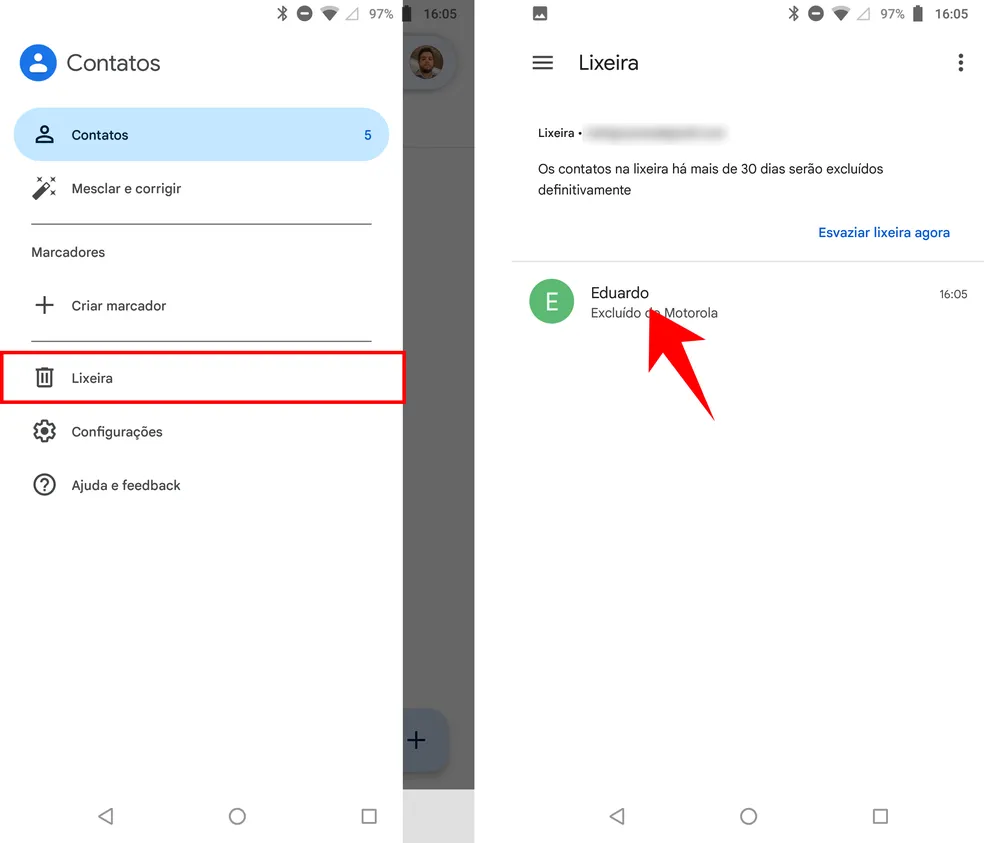
The Google “Contacts” app has a functionality that stores deleted data in the trash for up to 30 days, allowing for simple contact recovery.
- Open the “Contacts” app: on the Android device, open the “Contacts” app;
- Access the trash menu: tap the menu icon (usually represented by three lines or dots) and select the “Trash” option;
- Select contacts for restoration: in the trash, identify the deleted contacts and choose those you wish to recover;
- Confirm restoration: click on “Restore” to reintegrate the contacts into your main address book.
This option is particularly useful for those who notice the deletion of contacts within the retention period offered by the application.
Other Tools and Applications
In addition to native methods, various third-party tools can also help in recovering deleted contacts on Android devices:
- Dr.Fone – Data Recovery for Android: works similarly to the iPhone version, allowing the recovery of contacts, messages, photos and other important data;
- EaseUS MobiSaver for Android: an intuitive solution that enables the restoration of lost information, with a simple interface and guided process;
- Tenorshare UltData for Android: a comprehensive tool that assists in the recovery of various types of data, including contacts and deleted files.
In general, these applications may require the device to have USB debugging enabled and, in some cases, specific drivers to be installed on the computer. It is essential to follow the manufacturer's instructions to avoid risks and ensure data security.
Tips to Prevent Contact Loss
Preventing contact loss is as important as knowing how to recover them. Adopting security measures can avoid complicated situations in the future. Check out some essential tips:
Perform Regular Backups
- Automatic synchronization: activate automatic synchronization with your Google account (on Android) or iCloud (on iPhone) to keep data always updated;
- Manual backups: periodically, export your contacts to a .vcf file or use the native backup options of the operating systems;
- External storage: consider saving your contacts in cloud storage services or external devices, ensuring that a copy is always available.
Keep Synchronization Active
- Periodic check: after software updates or changes to device settings, check if contact synchronization remains active;
- Multiple services: using more than one backup method, such as synchronization with Google and manual export of contacts, can offer an extra layer of security.
Attention with Third-Party Applications
- Conscious choice: before installing applications for data management or recovery, check the evaluations and the developer's reputation;
- Adequate permissions: be suspicious of applications that request unnecessary permissions or access to data irrelevant to their function;
- Constant updates: prefer applications that are frequently updated and have active support to avoid vulnerabilities.
Education and Awareness
- Training: informing yourself about the functionalities of devices can help avoid common errors, such as accidental deletion of contacts;
- Alert messages: pay attention to messages and alerts issued by operating systems when performing critical operations, such as data deletion;
- Maintenance routine: establish a routine to review and organize contacts, ensuring that outdated information is removed without compromising important data.
By adopting these preventive measures, you not only protect user data but also facilitate recovery in case of any unforeseen events.
Recurring Questions
Below we present some of the recurring questions related to contact recovery and their answers:
1. What to do if there is no contact backup?
If there is no backup available, recovery can become more challenging. Data recovery applications can be an alternative, but the effectiveness of these methods decreases as time passes after deletion and continued use of the device. It is essential to try to act as quickly as possible to increase the chances of recovery.
2. Is it possible to recover permanently deleted contacts?
Contact recovery depends on the elapsed time and the overwriting of new data. If the deletion is recent and the device has not been used intensively after the event, the chances of recovery are greater. However, after a period, the data may be overwritten, making restoration difficult or impossible.
3. Are native methods effective for restoring deleted contacts?
Yes, native methods, such as using iCloud on iPhone and the Google account on Android, are generally effective in recovering contacts, as long as the backups are updated and synchronization has been maintained. However, if the backups do not contain the desired data, it may be necessary to resort to specialized applications.
4. Are third-party applications safe for data recovery?
Third-party applications, when chosen based on evaluations and recommendations from reliable sources, are usually safe. Tools like Dr.Fone, EaseUS MobiSaver and Tenorshare UltData are often used and recommended, but it is essential to download them only from official sources and keep the device protected with antivirus and regular updates.
5. What does the expression “x” mentioned in the guidelines mean?
The expression “x” was included in the guidelines as a marker to reinforce the integration of relevant terms and keywords in the text. Although it seems generic, it serves to remind the importance of distributing keywords throughout the article, contributing to content optimization.
Conclusion
Recovering deleted contacts, whether on iPhone or Android, is a challenge that can be overcome with the correct strategies. This article presented effective methods to restore the address book, using both the native resources of the operating systems and renowned third-party applications.
The importance of keeping regular backups and activating synchronization cannot be underestimated, as they are essential preventive measures to avoid data loss. By following the detailed instructions, users can choose the method that best suits their situation and recover their contacts quickly and safely.

